

Ventilation Systems for Bristol Homes
Experiencing condensation, damp, stale air? We install MVHR and PIV ventilation systems that fix that properly.
- 0117 964 0078
Is your Home Getting Enough Fresh Air?
Most of us don’t think much about the air inside our homes — until something feels wrong. Condensation forming on windows every morning. A persistent musty smell you can’t trace. Mould creeping into the corners of rooms. Allergies that seem worse indoors than out.
The irony is that many modern Bristol homes have this problem precisely because they’re well built. Improved insulation and draught-proofing — things that keep your heating bills down — also reduce the natural airflow that older properties relied on. The result is that moisture, stale air, and pollutants get trapped inside with nowhere to go.
The good news is there’s a straightforward fix. A properly installed home ventilation system continuously brings fresh air in and removes stale air out, controlling moisture before it becomes a problem and keeping the air your family breathes genuinely clean.
We install two types of system — MVHR and PIV — and we’ll always recommend whichever one is the right fit for your home, not the most expensive option.
Two Systems, One Specialist Team
There are two main types of residential ventilation system — MVHR (Mechanical Ventilation with Heat Recovery) and PIV (Positive Input Ventilation). Both do an excellent job of improving air quality and controlling moisture. The difference is in how they work, and which properties they suit best.
As a Gas Safe registered company serving Bristol and the surrounding area, we install, commission, and maintain both. We’ll carry out a free survey of your property and give you a clear, honest recommendation — with no pressure to spend more than you need to.
MVHR — Mechanical Ventilation with Heat Recovery
The smart choice for well-insulated and newly built homes — MVHR continuously supplies fresh filtered air to every room while recovering up to 95% of the heat that would otherwise be lost.
PIV — Positive Input Ventilation
The most practical solution for most existing Bristol homes — PIV gently pushes fresh filtered air through your property, eliminating condensation and stale air without the need for complex ductwork.
What is an MVHR System?
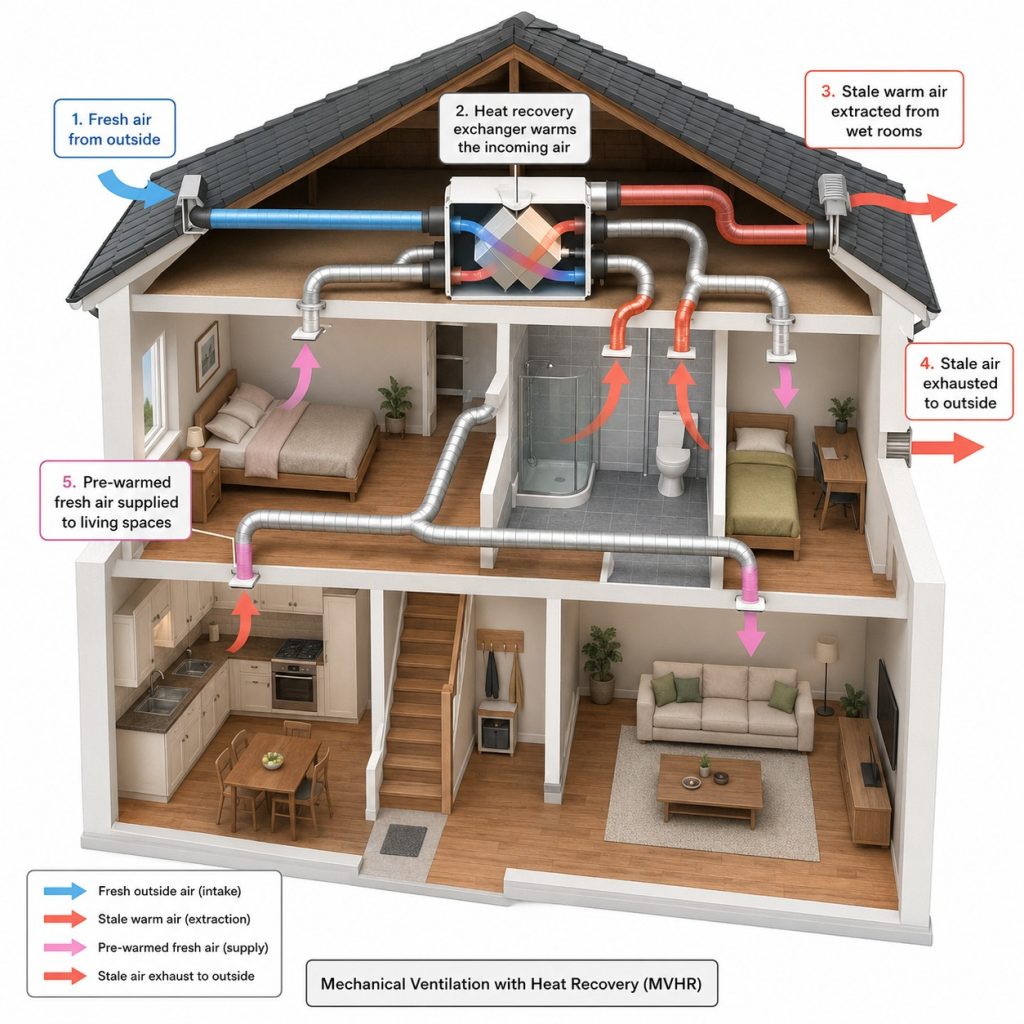
MVHR stands for Mechanical Ventilation with Heat Recovery. It’s a whole-house ventilation system that continuously supplies fresh, filtered air to every room while simultaneously extracting the stale, humid air out — and here’s the clever part: it recovers most of the heat from that outgoing air before it leaves the building.
Inside the MVHR unit sits a heat exchanger. The warm stale air being extracted and the cool fresh air coming in pass through separate channels in the exchanger, sitting close enough together that heat transfers between them — without the two airstreams ever mixing. By the time the fresh air reaches your rooms, it’s already been warmed using energy that would otherwise have been lost. A quality MVHR system recovers up to 95% of that heat.
The system runs on two sets of ducts that run discreetly through the property — one supply circuit bringing fresh air in, one extract circuit taking stale air out. Nuaire units, which we install throughout Bristol, are designed and manufactured in the UK and are among the most reliable on the market.
What are the Benefits of an MVHR System?
MVHR does more than just move air around. A well-designed system transforms the indoor environment of a home — with benefits that go well beyond simply stopping condensation.
Here’s what you can expect:
- Cleaner air, every room, all year. Fresh filtered air arrives continuously, so you’re never relying on opening windows in Bristol’s cold and wet weather. Dust, pollen, and airborne pollutants are filtered out before the air even enters the building — a real difference for anyone with allergies or asthma.
- Lower heating bills. The system recovers heat from outgoing air and uses it to warm the fresh air coming in, so your boiler has less work to do. In a well-insulated home, the savings can be meaningful over time.
- No condensation, damp, or mould. Moisture is continuously drawn out of bathrooms, kitchens, and living spaces — so the conditions that cause damp and mould simply don’t get the chance to take hold.
- Quiet and unobtrusive. Once commissioned and balanced correctly, most homeowners barely notice it’s running — until they notice how much fresher and more comfortable their home feels.
Is MVHR Right for Your Home?
- Building a new home — MVHR is easiest to design in from the start and gives the best long-term results.
- Carrying out a full renovation or deep retrofit — plan the ductwork as part of the project and installation is straightforward.
- In a home built to higher energy efficiency standards — the more airtight the property, the harder MVHR works for you.
Installation involves running ductwork through the property — typically through the loft and into rooms via ceiling or wall vents. It’s more involved than a PIV system, which is why it works best when planned ahead rather than bolted on afterwards. That said, it can absolutely be retrofitted into existing homes where the layout allows.
The upfront cost is higher than PIV. But the energy savings, combined with the quality of indoor environment it creates, mean it pays back over time — and in a well-insulated Bristol home, often sooner than you’d expect.
What is Positive Input Ventilation?
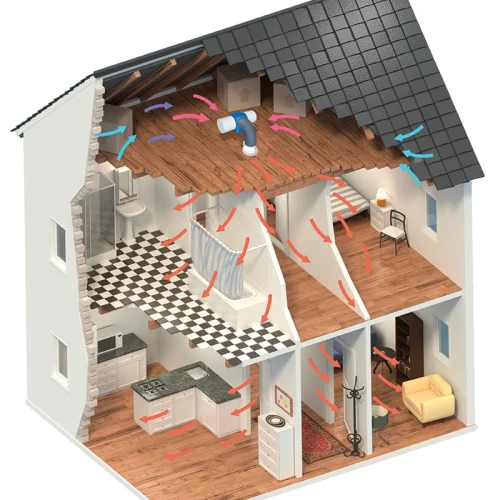
PIV stands for Positive Input Ventilation. It’s a simple, highly effective whole-house ventilation solution that works by drawing fresh air in from outside, filtering it, and gently pushing it into your home through a ceiling-mounted diffuser — usually fitted in a central hallway or landing.
That steady supply of fresh air creates a slight positive pressure inside the property, which gradually displaces the stale, humid air out through the natural gaps that exist in every UK home — around windows, doors, and throughout the building fabric.
There are no extract ducts running through the property and no complex ductwork to install. The unit itself, a Nuaire model in our installations, sits neatly in the loft and is barely noticeable once fitted. In properties without a loft — flats, for example — a wall-mounted version can be used instead.
Benefits of a PIV System
- Cheap to run. Typically just £7 to £10 per year in electricity — that’s less than 2p a day.
- Fast, tidy installation. Most installs are completed in two to three hours with minimal disruption to your home.
- Results you’ll notice quickly. Condensation on windows typically disappears within days. Persistent damp smells clear as the air is continuously refreshed.
- Tackles mould at the source. Mould keeps returning when conditions are right for it — stagnant, humid air. PIV removes those conditions, so it loses its foothold for good.
- Cleaner air throughout. Incoming air is filtered before it enters your home, removing dust, allergens, and airborne particles — a genuine benefit for anyone with respiratory conditions or allergies.
- Smart seasonal adjustment. Nuaire units include a summer bypass feature that automatically adjusts airflow in warmer months, so the system always performs appropriately for the conditions outside.
Is PIV Right for Your Home?
PIV suits most existing Bristol homes. It’s particularly well matched if your property is:
- A Victorian or Edwardian terrace — older homes with natural draughts are exactly what PIV is designed for.
- A semi-detached or detached house — straightforward to install, quick results.
- A rental property — a reliable, low-maintenance way to prevent condensation and protect the building and its occupants.
If you’re dealing with condensation, recurring mould, or simply want better air quality without a major project, PIV is usually the most practical starting point. Most homes with a loft space are suitable and installation can typically be arranged quickly.
PIV is less suited to brand-new, highly airtight homes — in those cases, MVHR is usually the better technical fit. Not sure which applies to you? That’s exactly what our free survey is for.

Trusted Installers of Nuaire Ventilation Systems
Nuaire have been designing and manufacturing ventilation systems in Wales since 1966, and their products are trusted by homeowners, housing associations, and developers right across the UK.
MVHR or PIV - Which Ventilation Systems do you Need?
Both systems will improve your home’s air quality and tackle condensation and damp. The right choice depends on your property, your budget, and whether you’re planning building work. Use this table as a guide — and if you’re still not sure, just ask us.
| MVHR | PIV | |
|---|---|---|
| Best for | New builds and airtight homes | Existing homes and older properties |
| Installation | Full ductwork throughout the property | Single loft or wall-mounted unit |
| Upfront cost | Higher investment | More affordable |
| Running cost | Very low — heat recovery reduces heating bills | Very low — typically around £7 per year |
| Air quality | Whole-house balanced ventilation | Whole-house positive pressure ventilation |
| Damp & condensation | Excellent | Excellent |
| Installation disruption | Higher — ductwork throughout the home | Minimal — often completed in a few hours |
| Ideal property type | Well-insulated new builds, deep retrofits, passive house | Older homes, rental properties, properties with existing damp |
Not sure which is right for you? We’ll assess your property and give you a straight answer — no sales pressure, just honest advice.
Common Questions About Home
Ventilation Systems
Take a look at some of our most frequently asked questions about our range of A-rated boilers. You’ll be surprised at how big a difference a new A-rated boiler can make to your home and your energy bills.
What is the difference between MVHR and PIV ventilation?
MVHR is a balanced whole-house system that supplies fresh air and extracts stale air simultaneously, recovering heat in the process. PIV works differently — it introduces fresh filtered air into the home, creating a positive pressure that pushes stale air out through natural gaps in the building. MVHR is typically the better choice for new builds and airtight homes; PIV is simpler, more affordable, and suits most existing properties very well.
How much does a home ventilation system cost in the UK?
PIV systems are the more affordable option and are typically installed for a fraction of the cost of MVHR. MVHR involves more equipment and ductwork throughout the property, so the investment is higher — but the energy savings from heat recovery can offset this over time. We’ll give you a clear, itemised quote following your free survey, so you know exactly what’s involved before committing to anything.
Will a ventilation system stop condensation and mould?
Yes, in most cases. Condensation forms when warm, humid air meets a cold surface — and it’s a sign that moisture has nowhere to go. Both MVHR and PIV continuously remove that excess moisture from the air before it can condense on windows, walls, and ceilings. Most homeowners with a PIV system notice condensation reducing significantly within the first week. Where mould has already established itself, the ventilation system prevents it from returning once the affected areas have been treated.
How much does a ventilation system cost to run?
PIV units are extremely economical to run — a Nuaire unit typically costs around £7 to £10 per year in electricity. MVHR systems use slightly more electricity to power the fans and controls, but the heat they recover from outgoing air reduces your heating demand, which usually more than compensates for the running cost. In a well-insulated home, MVHR can produce a net saving on energy bills.
Do I need planning permission to install a ventilation system?
In most cases, no. Domestic ventilation systems are generally covered by permitted development rights and don’t require planning permission. All our installations comply with Approved Document F of the Building Regulations, which sets out the ventilation requirements for UK homes. We handle all of this as part of our service — you won’t need to worry about the paperwork.
How long does installation take?
A PIV unit can usually be installed in two to three hours with minimal disruption — most homeowners are surprised by how quick and tidy the process is. MVHR installation takes longer, as it involves designing and fitting a ductwork system throughout the property. The timescale depends on the size and layout of your home, and we’ll give you a clear picture of what to expect during your survey.
Can MVHR be fitted in an existing home?
Yes, though it’s more straightforward when planned as part of a new build or major renovation. Retrofitting MVHR into an existing property requires routing ductwork through the home, which involves some disruption. In many Bristol homes — particularly those with accessible loft space — it’s entirely achievable. We’ll assess your property during the free survey and give you an honest view of whether it’s practical and cost-effective for your situation.
Get a Free Ventilation Survey in Bristol
- Call: 0117 964 0078
- Email: response@gassafe-bristol.com
Fill out our contact form
Why Choose Gas Safe Bristol
We’re a Gas Safe registered company based in Bristol, and ventilation is a core part of what we do — not an add-on. When you book a survey with us, you’re talking to engineers who install and commission these systems day in, day out across the city and the surrounding area.
- Local engineers with 20+ years experience
- Nuaire Approved Installers
- 5-star rated on Google
- Fully accredited and insured
- Honest Advice, Always
We install MVHR and PIV ventilation systems throughout Bristol and the wider South West. Whether you’re in the city centre or further afield. We cover areas including Clifton, Redland, Bishopston, Horfield, Filton, Henleaze, Westbury-on-Trym, Stoke Bishop, Bedminster, Brislington, Knowle, Fishponds, Staple Hill, Kingswood, and Southmead